


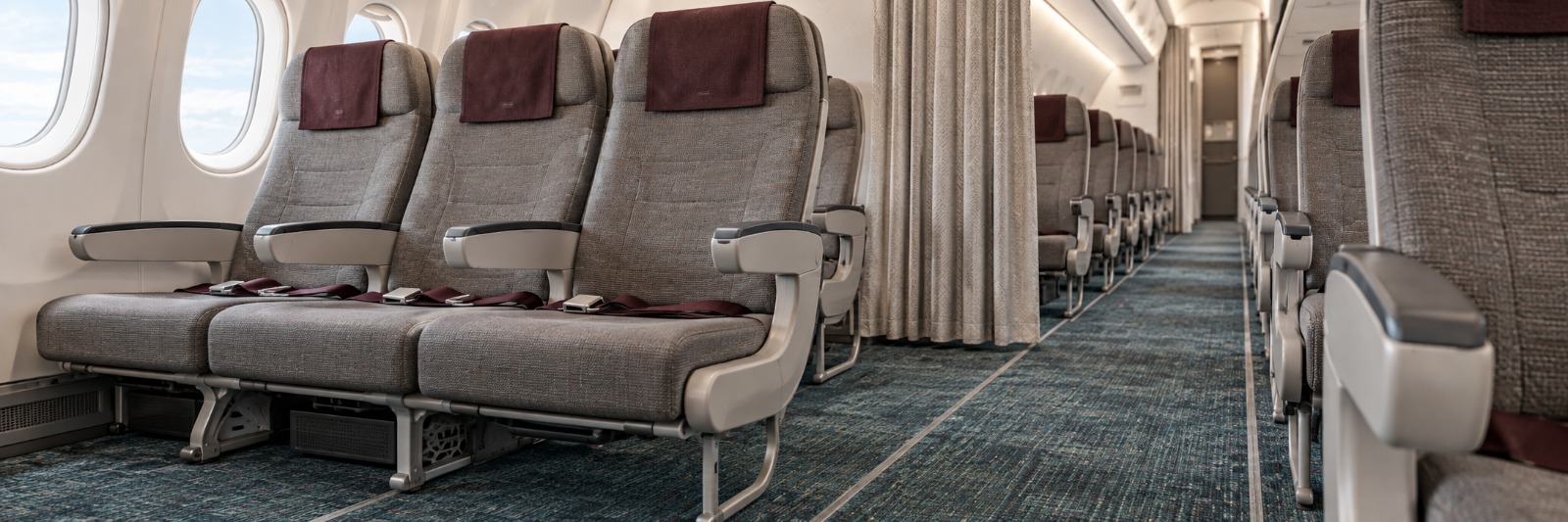
Aircraft interior textiles are the certified fabrics that dress a commercial cabin: carpets, seat covers, curtains and cushions. They resist wear, meet aviation fire standards, and combine wear resistance, durability and consistent technical performance throughout their service life. Industrial Neotex has engineered these textiles for commercial aircraft interiors for 40 years. Every product is designed, produced and approved under EASA and OEM frameworks. This page groups our cabin textile range, the standards behind it, and how we support airlines across the aircraft lifecycle.
Aircraft interior textiles in the commercial cabin
Aircraft interior textiles are technical fabrics built for the cabin, not for consumer use. They have properties standard textiles lack: certified fire behaviour, high abrasion resistance, low weight, colour fastness, and easy cleaning and disinfection. In commercial aviation, passenger zones use carpet on the floor, fabric or leather on seats, and textile curtains between classes and galleys. Each material is selected for its position, its wear profile, and its certification path. Beyond technical performance, these textiles enhance passenger comfort and express the airline’s brand identity through colour, texture and design.
Certified aviation textiles: approvals and fire standards
Certification in aviation is layered, and the layers are not interchangeable. Industrial Neotex holds four distinct types of approval.
Quality management: ISO 9001 and EN 9100
ISO 9001 (since 2000) and EN 9100 (since 2005) govern how we design and manufacture cabin textiles.
EASA approvals: DOA, POA, MOA
We hold EASA Part 21J Design Organisation Approval (DOA), Part 21G Production Organisation Approval (POA) and Part 145 Maintenance Organisation Approval (MOA).
Industrial Neotex is also registered with the Ministry of Defence under NCAGE code 0008B. A registration is not a certificate.
Product conformity to fire standards
Each textile is tested against the fire standard that applies to its material, use and configuration.
Flame retardant textiles and CS/FAR 25.853
Cabin textiles must meet CS 25.853 and Appendix F in Europe, and FAR 25.853 in the United States. The exact test depends on the material, its cabin position, and its configuration. We do not claim a single test covers every product; we validate each textile against the requirement that applies to it.
OEM and customer approvals
Leading commercial OEMs approve our textiles for their programmes. These approvals sit alongside EASA approval; they do not replace it.
The aircraft interior textiles range
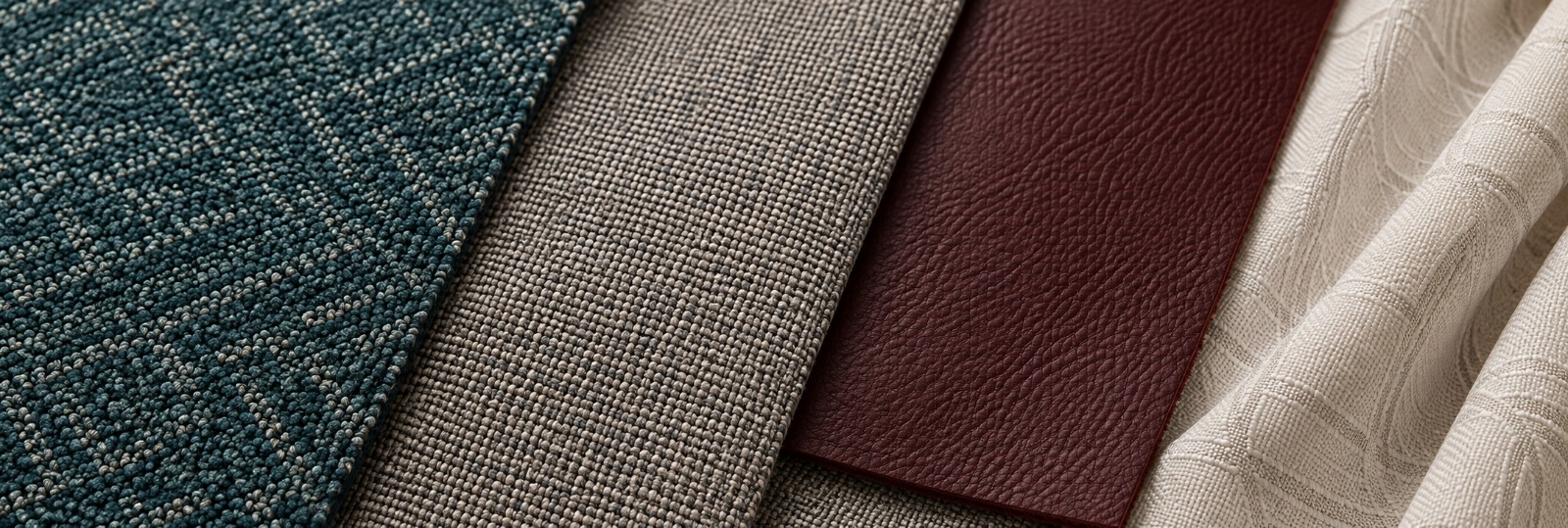
Our range covers the four textile surfaces of a commercial cabin.
Aircraft carpet
We produce commercial aircraft carpet in 100% recycled nylon, as well as wool and wool blends. ReadyFit precut carpet ships ready to install and cut, reducing fitting time on the aircraft. NeoDye Carpets are printed with waterless digital technology for precise, repeatable designs. CarpetCare, our MRO service, keeps carpet in service longer through scheduled cleaning and disinfection. At each thickness, it is the lightest carpet on the market.
Aircraft seat covers and upholstery
We supply certified seat covers and upholstery for commercial cabins. We work with leather, wool and technical blends. LeatherFlight is our vegan leather option, with added flame-retardant treatment for cabin use.
Aircraft curtains and dividers
Our curtains separate classes, galleys and lavatories. Trevira curtains use 90% recycled fibre; wool-blend curtains use 90% virgin wool with 10% polyamide for durability.
Cabin cushions
We complete the cabin with certified cushions matched to the seat and carpet programme.
Cabin experience and airline branding
Cabin textiles shape how passengers experience the cabin and how an airline shows its brand. Carpet, seat covers, and curtains carry colour, pattern and identity along the whole cabin. With digital printing, an airline turns these surfaces into a branding channel, reproducing its own designs precisely and on demand.
NeoDye digital printing for cabin textiles
NeoDye is our proprietary digital textile printing technology. It prints designs directly onto textiles without water in the dyeing stage. The result is precise, repeatable colour with a lower environmental footprint than conventional dyeing. NeoDye Technology is the process; NeoDye Carpets is the product line it prints.
Sustainable aircraft interior textiles
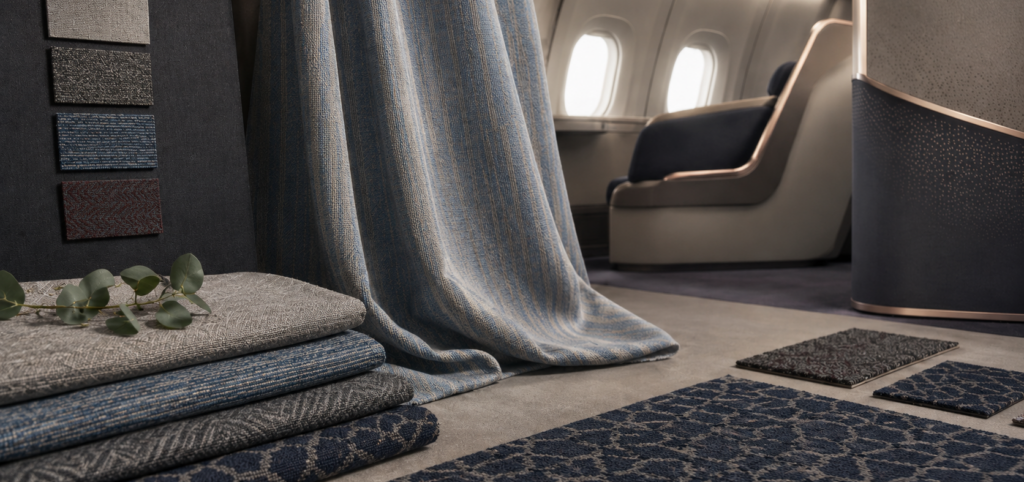
Our claim is direct: sustainable high-performance textiles for tomorrow’s cabin. We build recycled content into the material, not only the message. Carpets use 100% recycled nylon; Trevira curtains use 90% recycled fibre. NeoDye removes water from the dyeing stage. We validate every sustainability claim before we publish it.
Aircraft textile MRO: cleaning, repair, reconditioning
Our work does not end at manufacturing. We recondition, repair, clean and disinfect cabin textiles across their service life. CarpetCare frequency depends on use: high-traffic carpet every 6 to 12 months, low-traffic up to 24 months, and full cabin retrofit around every 6 years.
Your aircraft interior textiles supplier
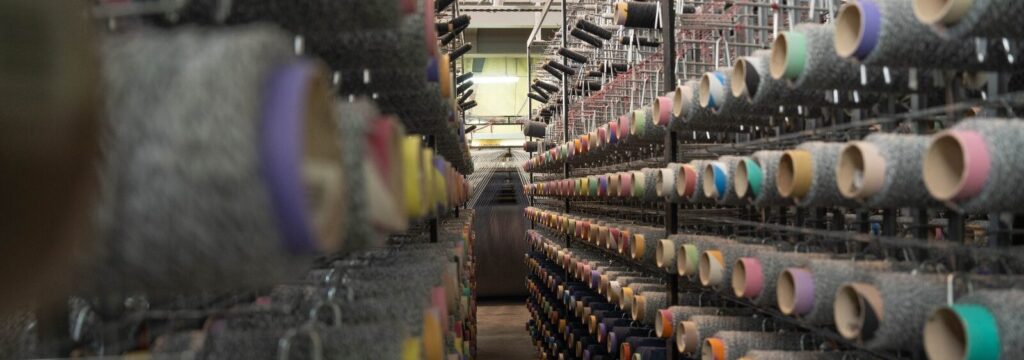
Industrial Neotex has delivered certified textile solutions for commercial and corporate aircraft interiors for 40 years. We hold EASA Part 21J, Part 21G and Part 145 approvals, and we are an approved textile supplier to leading commercial OEMs, including Airbus, Boeing and Embraer. Our textiles are designed, produced and maintained in-house, under one quality system.
Aircraft interior textiles: FAQ
What are aircraft interior textiles?
Certified technical fabrics for the commercial cabin – carpets, seat covers, curtains and cushions – engineered for fire safety, abrasion resistance, low weight, long-lasting colour and easy cleaning.
What fire standards do aircraft cabin textiles meet?
In Europe, CS 25.853 and Appendix F; in the United States, FAR 25.853. The applicable test depends on the material, its cabin position and its configuration.
Are aircraft carpets recyclable?
Our recycled-nylon aircraft carpets use face yarn made from 100% recycled nylon. However, the current backing prevents end-of-life recycling. We are developing a separable backing to allow the nylon face yarn to be recovered for recycling. Wool carpet fibres can also be recovered and repurposed for use in nonwoven textiles.
How often should aircraft carpet be maintained or replaced?
High-traffic carpet is serviced every 6 to 12 months, low-traffic up to 24 months, with full cabin retrofit around every 6 years.
What certifications does an aircraft textile supplier need?
Four distinct layers: a quality system (ISO 9001, EN 9100), organisation approvals (EASA Part 21J, 21G, 145), product conformity to fire standards, and customer/OEM approvals.
What is NeoDye?
Industrial Neotex’s proprietary waterless digital textile printing technology, which prints cabin textile designs without water in the dyeing stage.