


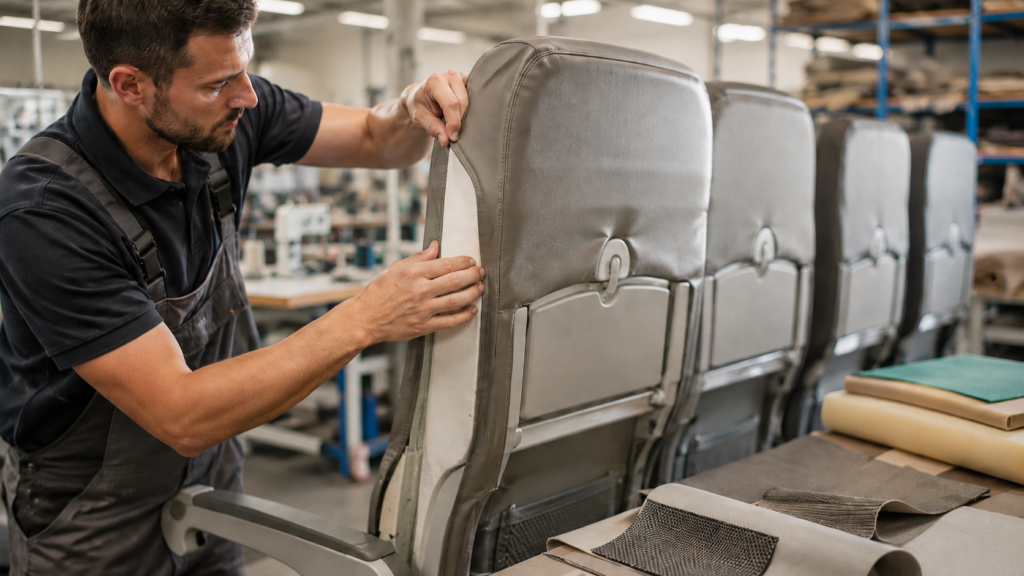
Key takeaways about aircraft seat covers
- Aircraft seat covers balance passenger comfort, fire safety and aviation certification at once.
- They are the outer textile layer, over the cushioning and any fire blocking layer.
- They can be adapted to each airline’s brand identity, coordinating design, colour and finish with the seat and the cabin.
- As the outermost layer, they shape the seat’s fire behaviour.
- They must meet CS 25.853 and FAR 25.853, with the test appropriate to location.
- Certification is multi-layered: aircraft manufacturer, airline and the supplier’s FAI.
- They work with the seat cushions and the Fire Blocking layer.
- Conformity is documented through AeroCert Suite.
An aircraft seat cover has to solve three things at once that can seem to pull in different directions: passenger comfort, fire safety and aviation certification.
So are they really certified for aviation? How do they shape comfort and safety? This guide answers each. For the full view of materials and replacement, see our aircraft seat covers guide.
What are aircraft seat covers?
The cover is the outer textile layer of the seat, over the cushioning and any fire blocking layer, and the surface the passenger sees and touches.
Why are they a safety component?
As the outermost layer, the cover is the first material a flame would meet, so its reaction to fire affects the safety of the whole seat.
What materials are they made of?
Aircraft seat covers are built from technical fabrics or leather, chosen for durability, weight, ease of cleaning and colour fastness. The choice follows the airline’s positioning and cycles of use.
How do they shape comfort?
Comfort is not only the foam. The cover shapes the seat’s feel, breathability and thermal sensation, and a good fabric holds those qualities across thousands of use and cleaning cycles. The cover works together with the seat cushions.
How do they behave in a fire?
Covers must comply with EASA CS 25.853 and FAR 25.853, with the test appropriate to location. There is no single blanket test: it depends on the material and configuration, and behaviour is validated on the complete seat, alongside the foam and the Fire Blocking layer.
How are they certified?
Certification is multi-layered. Beyond the fire test, the cover is qualified by the aircraft manufacturer and the airline, with the supplier approved through First Article Inspection, documented through AeroCert Suite.
Frequently asked questions about aircraft seat covers
Are aircraft seat covers certified for aviation?
Yes. They are qualified against CS 25.853 (and FAR 25.853 in the US) with the flammability method appropriate to their location, and they are also approved by the aircraft manufacturer and the airline, with the supplier qualified through First Article Inspection. Fire performance is validated on the complete seat.
Can seat covers be recycled?
Increasingly, constructions prioritise recycled and recyclable materials compatible with aerospace requirements.
Specifying aircraft seat covers means balancing comfort, safety and certification. For your programme, request samples.